The two kinds of question travelers ask AI about your destination
Some questions name your destination. Most do not. Each kind tells a tourism board something different, and you need both to see how AI treats you.
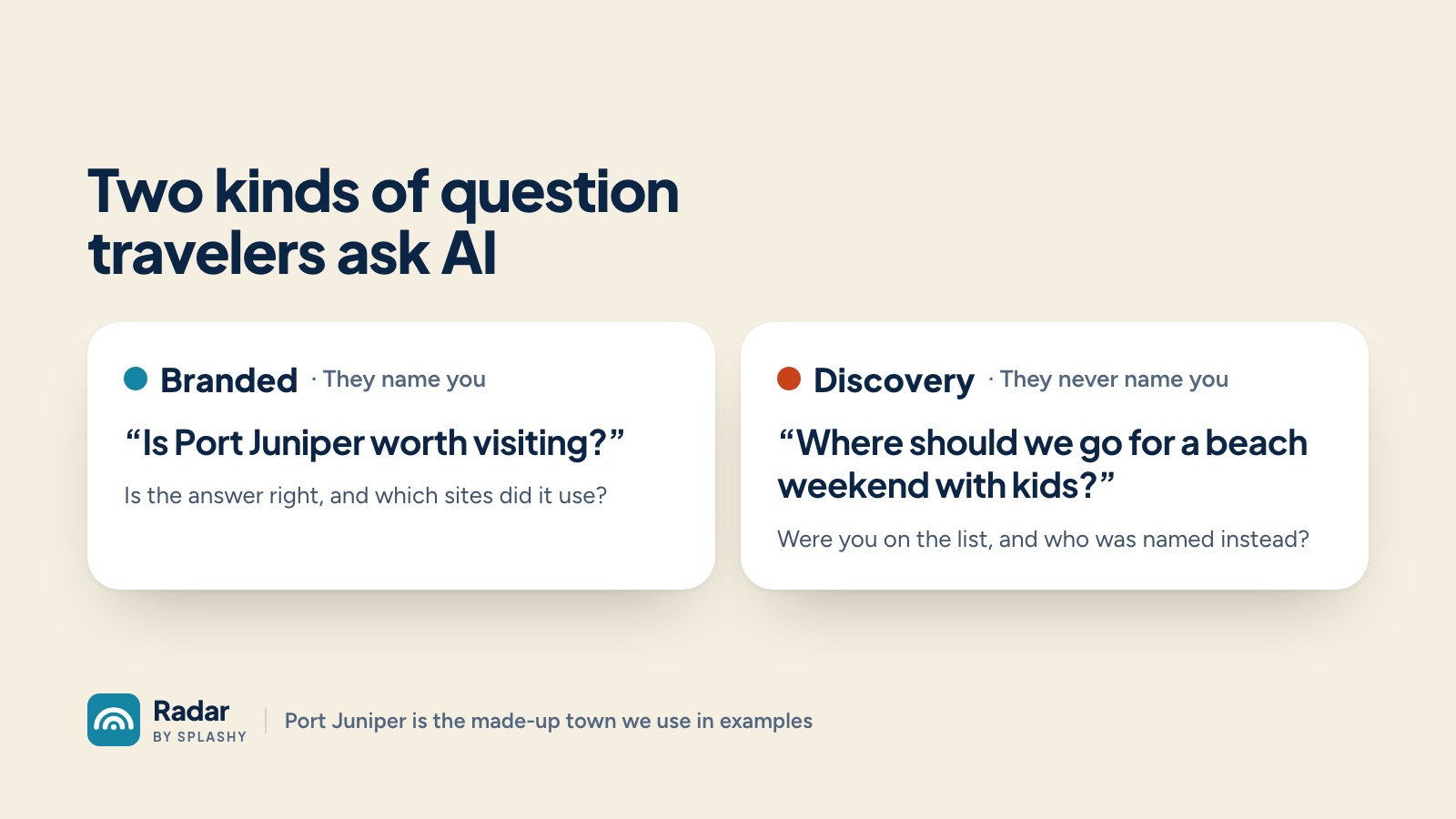
Travelers now ask ChatGPT, Gemini and Google where to go next. If you market a place, the useful thing to know is what those answers say, and the questions fall into two kinds.
Branded questions name you
A branded question has your destination in it. “Is Port Juniper worth visiting?” is one. (Port Juniper is a made-up town we use in our examples.) So is “What is there to do in Port Juniper in October?”
Someone asking a branded question already has you in mind. What matters is whether the answer is right, and where it came from. Read these answers for two things:
- What AI says about you. Is the festival on the right weekend? Is the aquarium still described as “new”? AI repeats what it has read, and some of what it has read is old.
- Which sites it cites. On a question about your own destination, your own website should be the source AI leans on most. If a booking site or a forum thread is ahead of you, that is worth knowing.
Discovery questions leave you out
A discovery question describes a trip and never names you. “What are the best seafood towns on the Southeast coast?” “Where should we go for a beach weekend with kids?”
This is where a traveler is still choosing. AI answers with a short list of places, and you are either on it or you are not. Read these answers for three things:
- Whether you were named at all, and how often.
- Who was named instead. The places AI recommends in your spot are the ones you are really competing with, which is not always the list you would have written.
- What AI read. Each answer comes with sources. When AI recommends the town down the coast, it is usually repeating a magazine roundup, a forum thread or a guide. Those pages are the ones worth getting onto.
Why one answer is not enough
Ask the same question twice and you can get two different lists. Ask five assistants and you get five. A single screenshot of one answer tells you very little.
That is why Radar asks every question several times, across ChatGPT, Claude, Gemini, Perplexity and Google AI Overviews, and counts. A count across many answers is something you can track from week to week. “It mentioned us when I tried it” is not.
It is also why the wording stays the same from week to week. If the question does not change, a change in the answers is a real change.
What a tourism board can do with this
Nothing here is a trick for gaming AI. It is the same work a destination already does, pointed at better targets:
- Fix what is wrong at the source. If AI has a fact wrong, find where your own site is unclear or out of date and correct it there.
- Answer the questions people ask. If travelers keep asking something your site never answers plainly, write the answer.
- Know which outside pages matter. If three roundups drive most of what AI says about seafood towns, those are the editors to talk to.
- Watch it over time. A campaign, a new page or a piece of press should show up in the answers. If it does not, that is worth knowing too.
See it for your own destination
A sample sweep puts ten travel questions about your destination to five AI assistants and turns the answers into data. It is free and needs no card: run a sample sweep.