A weekly AI visibility routine for a DMO marketing team
A 30-minute Monday routine that turns a weekly AI visibility report into one concrete job for your marketing team.
Most tourism boards now know AI assistants are answering travelers' questions. Fewer have a plan for what to do about it each week. A dashboard that nobody opens does not change anything.
Here is a simple routine for a destination marketing team. It takes about half an hour on a Monday, and it turns a weekly AI visibility report into a short list of jobs that can bring in visitors.
The examples use Port Juniper, a made-up town, and the screens are from Radar by SPLASHY. The routine works with any steady weekly record of what AI says about you.
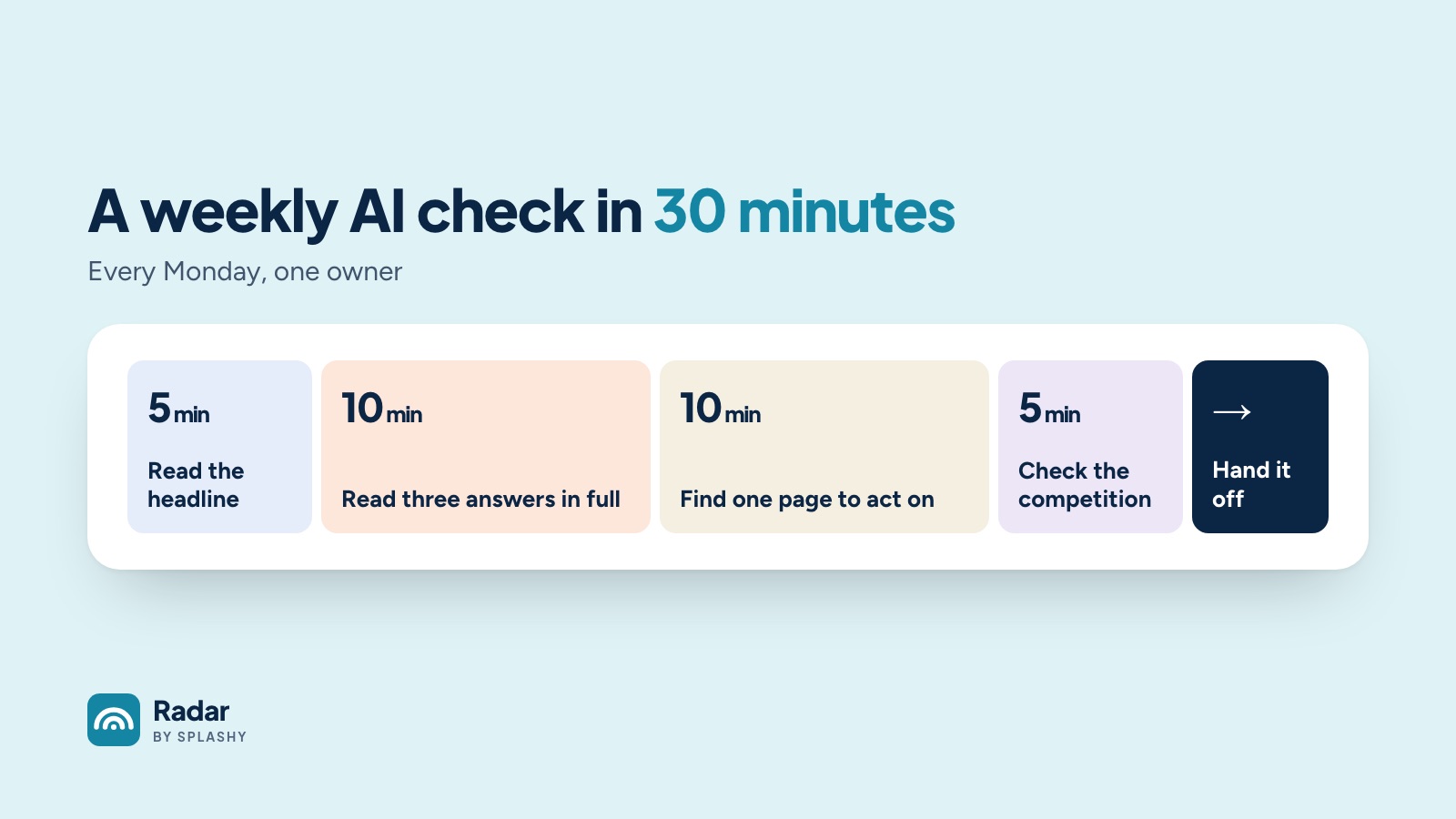
Monday: 30 minutes, one owner
Pick one person to own it. They do not need to be technical. They need to read carefully and pass work on.
Radar runs on your sweep day, which is Sunday for most accounts, so the new results are waiting on Monday. If your team gets the Monday "results are ready" email, use it as the reminder. Book the half hour for Monday morning.
1. Read the headline (5 minutes)
Open the Overview. Note two numbers:
- How often AI recommends you on discovery questions, the ones that describe a trip and do not name you. This is the closest thing to "did AI send us new visitors this week?"
- Where your own site ranks among the sources AI cited on questions about you.
Write both down beside last week's. Do not react to a small move. Radar marks a change of less than two points as about the same, and one week is only one week.
2. Read three answers in full (10 minutes)
Numbers tell you where to look. Answers tell you what to do.
Open the Prompts tab. Pick three questions: one that moved, one you care about commercially, and one at random. Read what each assistant actually said.
You are looking for:
- Wrong facts. An old festival date, a closed restaurant, a price from 2023.
- Missing things. Your new waterfront park is not mentioned anywhere.
- Who was named instead. If AI recommends the town down the coast for "romantic weekend", that is a competitor worth noting.
3. Find one page to act on (10 minutes)
Open the Sources tab. Look at the sites and pages AI cited most this week.
Then choose one action. Only one. For example:
- A page of yours to improve. AI keeps citing your old "Top 10 Things to Do" post. It is three years out of date. Refresh it.
- A page you should write. Travelers ask about parking for the beach and AI answers from a forum thread. Write the plain answer on your own site.
- An outside page to pitch. A regional magazine's "best seafood towns" list keeps feeding answers, and Port Juniper is not on it. That is a call for your PR lead.
4. Check the competition (5 minutes)
Open the Competitors tab. Pick the rival that moved most and look at the head-to-head. Note which questions they win and which sources back them.
5. Hand it off
Send one short message to the team with the two numbers, the one action and who owns it. That is the whole meeting.
Once a month: step back
Once a month, spend an hour on the bigger picture.
- Look at the trend, not the week. Has the headline number moved over four checks? Has your site's rank changed?
- Check last month's actions. Did the page you refreshed start to be cited? If the answers have not changed after a few weeks, try a different fix.
- Review your questions. Are they still the questions travelers ask? Add seasonal ones, retire ones that no longer matter.
- Review your competitors. If a place keeps showing up in the answers and you do not track it, add it.
Once a quarter: report it
Boards and partners want to know what changed and why it matters. Keep the report short:
- The headline number over the quarter, with the first and last check.
- Two or three examples of real answers, good and bad. Quotes make the case better than charts.
- What you did and what moved afterward.
If a partner or a board member wants to see one question for themselves, you can share it. In Radar, the Share button on a question makes a link that works for up to seven days without a login. It shows that one question and its answers, and nothing else.
Why it pays
The routine is small on purpose. One owner, one action a week, one honest number. Over a year, that is fifty pages fixed, written or pitched, each aimed at a question travelers are already asking AI.
Each of those is a chance for an AI answer to send a traveler to your site, your events and your partners, instead of to a booking platform or the town down the coast.
You can run a free sample sweep to see what your first Monday would look like.