Why AI cites review sites and forums instead of your website
AI often builds answers about your destination from review sites and forum threads; here is why, and what a tourism board can do about it.
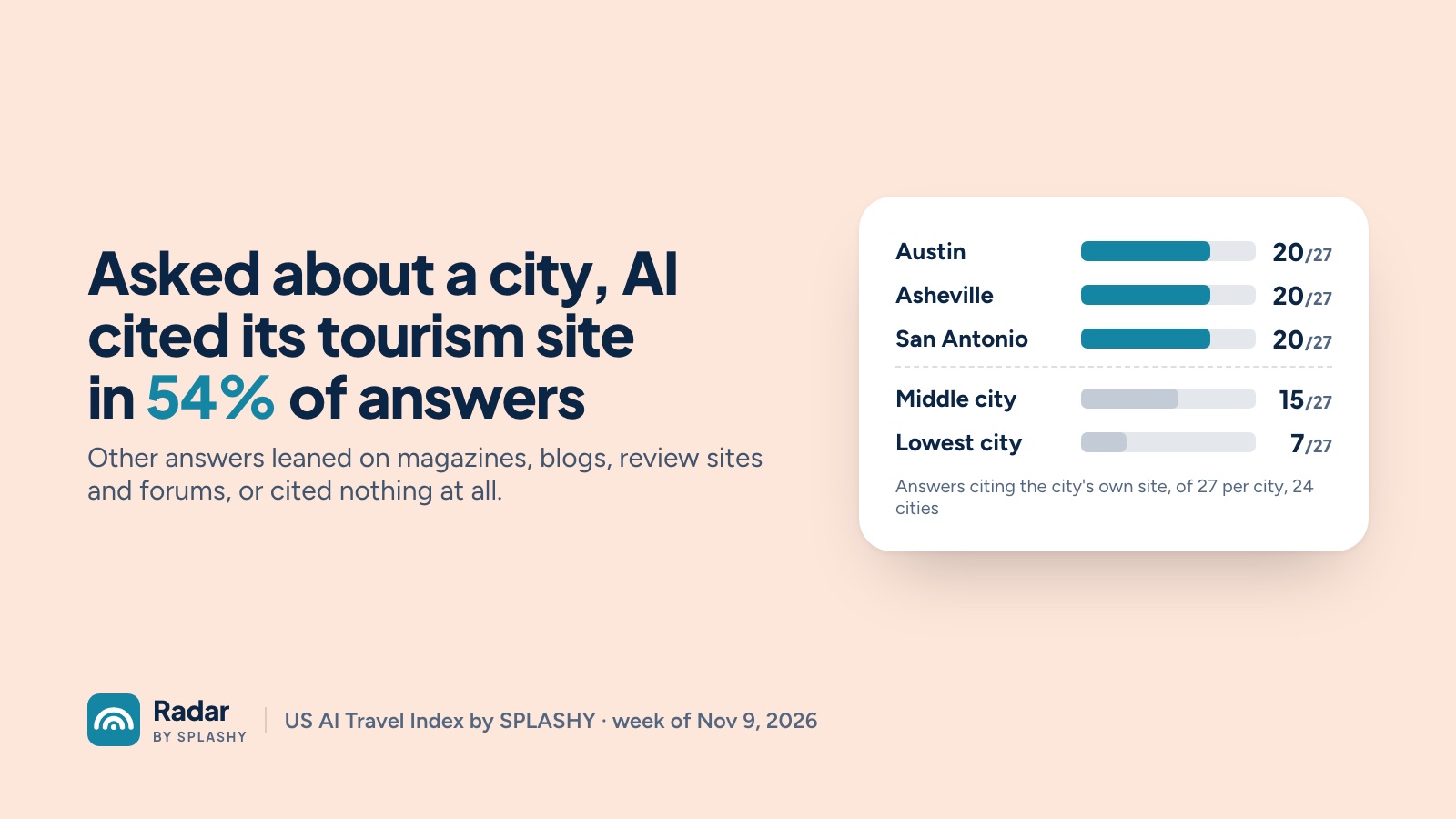
Ask an AI assistant about your destination by name and look at the sources under the answer. You might expect your own website at the top. Often it is there. Just as often the answer leans on a review site, a booking platform or a forum thread where a stranger answered the same question three years ago.
That is not because AI has something against tourism boards. It is because of what those other pages are good at, and what many official sites leave out. The good news is that most of the gap is fixable, and the fixes are ordinary marketing work.
Why AI reaches for other sites
When an assistant answers a travel question, it looks for pages that answer that question plainly. It favors pages that are specific, recent and easy to read. Review sites and forums often win on all three.
They answer the exact question. A traveler asks, "Is Port Juniper good for a weekend with a toddler?" (Port Juniper is the made-up town we use in examples.) A forum thread with that title, and twenty replies from parents, is a near-perfect match. A page called "Family Fun" with a photo carousel and three lines of copy is not.
They are full of detail. Review sites carry thousands of short, concrete reports: the wait at the crab shack on a Saturday, the beach with the gentle slope, the museum that takes an hour, not three. AI answers are built from details like these.
They feel current. New reviews and replies arrive every day. An official page that still promotes last year's festival dates tells AI, and the traveler, that it may be out of date.
They are easy to read. Many official sites put their best content inside maps, widgets, PDFs and listings that load after the page opens. A plain article is simpler for any reader to take in, including an AI tool reading the page's text.
They compare. Travelers ask "which" and "best" questions. Your site is, fairly, about you. A magazine roundup or a forum thread weighs you against the town down the coast, and that is the shape of the answer AI is trying to give.
What it costs you
When the answer is built from someone else's page, it repeats that page. If the forum thread says the boardwalk closes in October, so does the answer, even if it reopened in spring. If the review site's top list leaves out your newest attraction, so does the answer.
There is a revenue side too. An answer that cites your site gives a traveler a path to your events, your partners' listings and your booking links. An answer that cites a booking platform sends that traveler, and that click, somewhere else.
What a tourism board can do
None of this needs a trick. It needs your site to answer real questions as well as the forum does, and your effort pointed at the outside pages that matter.
- Write the answer, not the brochure. Pick the questions travelers ask most and give each a plain answer on one page. "Is Port Juniper good for families?" deserves a page that says yes, why, and which three things to do first, with ages, prices and times.
- Add the detail reviewers add. Opening hours, parking, how long things take, what is free, what to book ahead. Specific facts are what make a page worth citing.
- Keep dates and facts current. Put a review date on key pages and keep to it. Retire or update event pages when the event is over.
- Put the words on the page. Make sure your most important content is readable text, not only inside a map, a PDF or a widget.
- Fix the outside pages you can. Keep your listings on review and booking sites complete and accurate. They are going to be read either way.
- Pitch the pages AI already trusts. If one roundup or one guide keeps feeding answers about your area, that page is worth a call to its editor.
Find out which pages are winning
The hard part is knowing where to start. You cannot fix every page, and you should not guess which outside sites matter.
This is what the Sources tab in Radar by SPLASHY is for. Every week Radar asks five AI assistants the same questions about your destination and records every site and page each answer cites.
- Filter to Branded questions to see how much of what AI says about you comes from your own site, and where your site ranks among every source cited.
- See the mix by kind of site: your own site, travel platforms, media, community and social, and more.
- Open any source to see its most-cited pages and which of your questions it answers. If a forum thread is winning your "things to do with kids" questions, you will see that thread by name.
- Check your own pages on the Pages tab, to see which of your pages AI uses most.
Then you can make one page better, check the answers in a few weeks, and see whether AI started citing it. For more on the kinds of sites AI leans on, read which websites AI trusts for travel answers.
You can run a free sample sweep to see which sites AI reads about your destination today.